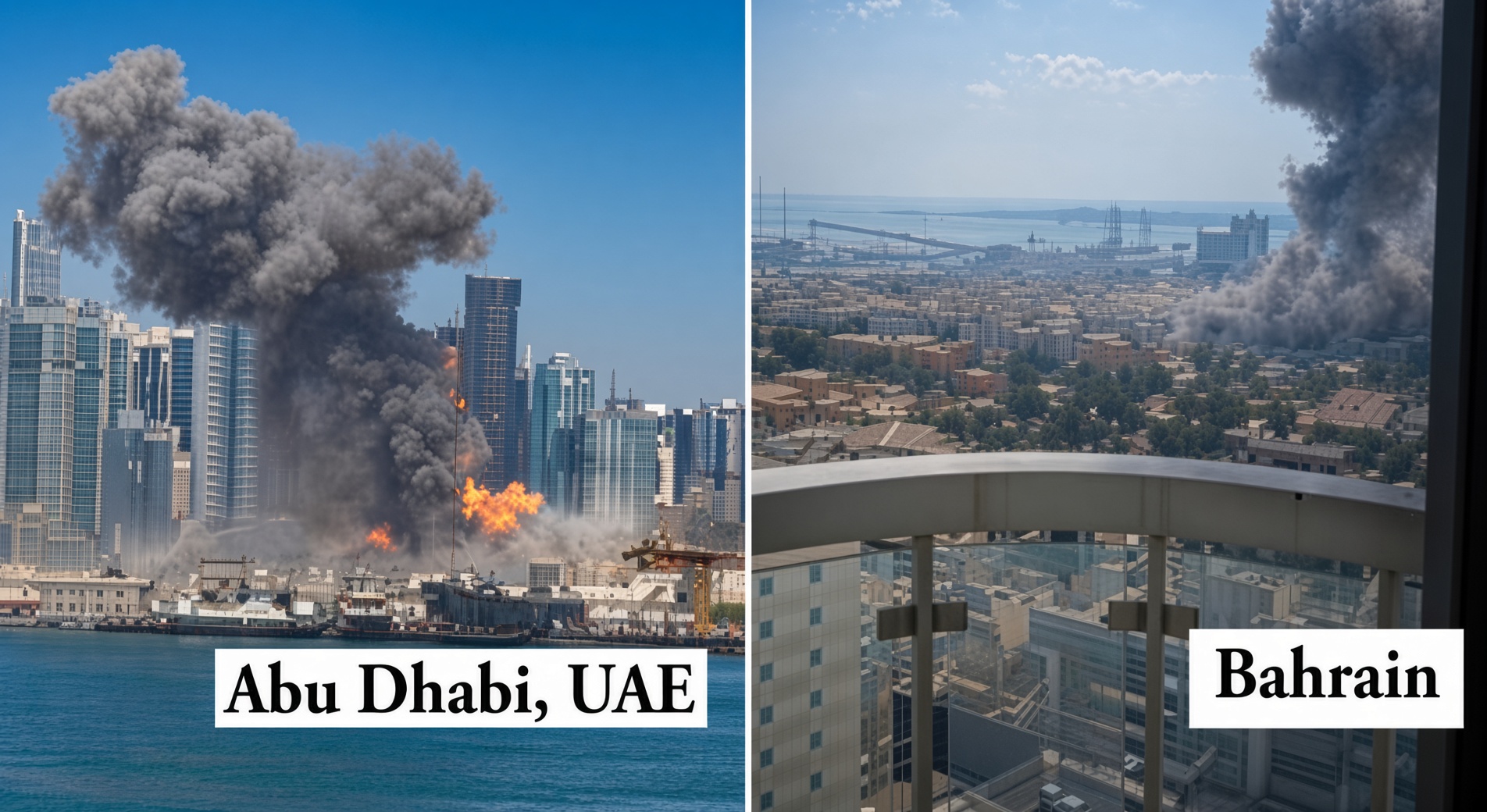
PERSIAN GULF — A wave of coordinated Iranian ballistic missile and one-way attack drone salvos targeted military installations and logistics infrastructure linked to American forces across the Persian Gulf, triggering mass air-defense activations, emergency civil-defense protocols, and renewed alarms over an unconstrained regional war.
The strikes have thrust four Gulf Cooperation Council (GCC) member states—Bahrain, Qatar, Kuwait, and the United Arab Emirates—directly into the crosshairs of the expanding kinetic confrontation between Washington and Tehran. While interceptor batteries largely engaged incoming salvos across multiple sectors, the multi-vector barrages underscore the acute operational vulnerability of Gulf monarchies hosting critical U.S. forward-operating bases and strategic command architectures.
The escalatory spiral follows months of maritime interdictions, drone skirmishes, and infrastructure strikes surrounding the Strait of Hormuz. U.S. Central Command (CENTCOM) confirmed ongoing theater-wide defensive maneuvers alongside retaliatory strikes directed against Islamic Revolutionary Guard Corps (IRGC) command-and-control nodes, unmanned aerial vehicle (UAV) assembly depots, and mobile coastal missile batteries.
Multi-Layered Air Defenses Tested in the Emirates
In the United Arab Emirates, defense forces maintained elevated readiness postures across major metropolitan zones and military compounds, with particular focus centered on Al Dhafra Air Base south of Abu Dhabi.
Al Dhafra functions as a premier logistical and air-combat pivot for American operations in the Middle East, hosting advanced multi-role fighter wings, airborne early warning aircraft, and reconnaissance assets. Over successive waves of retaliatory operations, the sector around the installation has witnessed continuous aerial intercepts, with MIM-104 Patriot batteries and Terminal High Altitude Area Defense (THAAD) systems engaging incoming threats.
Iranian military planners have repeatedly utilized mixed-salvo strike doctrines against UAE-based facilities, coordinating low-altitude loitering munitions with high-velocity ballistic arcs to saturate tracking arrays. While Gulf defense networks possess some of the most sophisticated Western-supplied interceptor shields in the world, the geographic dispersion of high-value civil targets—including desalinization plants, petroleum export terminals, international transit airports, and dense commercial centers—imposes severe strain on point-defense capabilities.
Naval Command Vulnerabilities in Bahrain
To the north, the Kingdom of Bahrain remains exposed due to its geographic footprint and its role as host to the headquarters of U.S. Naval Forces Central Command (NAVCENT) and the U.S. Navy’s Fifth Fleet.
The Fifth Fleet hub at the Jufair naval complex in Manama represents the principal nerve center for American maritime power projection across the Persian Gulf, the Gulf of Oman, the Red Sea, and portions of the Arabian Sea. Iranian military communiqués have repeatedly singled out Naval Support Activity Bahrain, triggering air-raid warnings and civil alert broadcasts across the capital as ship- and shore-based defense systems intercepted inbound drones and surface-to-surface missiles.
For Bahraini authorities, the tactical challenge is compounded by territorial density. Because military installations directly abut civilian communities, primary transport corridors, and urban commercial zones, intercept debris and proximity strikes present acute risks to non-combatant populations and vital public utilities.
Al Udeid and the Command Nerve Center in Qatar
In Qatar, strategic attention has centered on Al Udeid Air Base, an sprawling desert facility situated southwest of Doha that serves as the forward operational headquarters for CENTCOM.
Housing thousands of American and coalition service members, Al Udeid manages regional combined air operations, aerial refueling networks, and strategic theater airlift across an operational zone spanning hundreds of miles. An uncontained strike against the base risks degrading centralized combat command across the entire theater.
Qatari air defense units, coordinating closely with U.S. Air Forces Central (AFCENT) radar operators, have executed multiple high-altitude kinetic intercepts to disrupt incoming salvos. Nonetheless, the targeting of facilities inside Qatar has unsettled domestic authorities, highlighting how quickly strategic hub arrangements can convert non-belligerent nations into primary combat theaters.
Northern Buffer Zone Under Fire in Kuwait
Kuwait has similarly grappled with recurring missile and drone tracks originating from Iranian-controlled launch sites.
Iranian military leaders have claimed successive strikes aimed at forward staging hubs, logistics depots, and auxiliary airfields across Kuwait. The northern Gulf state has long served as a vital ground transit corridor and logistical backbone for American land forces operating under Operation Inherent Resolve.
Kuwaiti civil defense officials have sustained elevated warning protocols, urging domestic populations to monitor official broadcast frequencies and adhere to emergency curfew guidelines when interception alarms sound. The repeated targeting demonstrates the ease with which standoff weapons bypass geographic borders, transforming sovereign host nations into frontline zones of attritional conflict.
Chokepoint Economics and the Strait of Hormuz
The military standoff has reverberated through global supply chains, centered on the strategic vulnerability of the Strait of Hormuz. The narrow passage, which channels approximately 20 percent of worldwide petroleum shipments, has seen commercial traffic plunge as shipping syndicates reroute tonnage away from contested maritime coordinates.
Following tit-for-tat attacks on commercial commercial vessels and high-intensity missile exchanges over littoral waterways, international war-risk insurance premiums have surged to punitive levels. In response, energy-exporting nations have mobilized contingency bypass routes, with Saudi Arabia expanding throughput along its East-West crude pipeline to transit petroleum toward Red Sea loading terminals, attempting to circumvent the Persian Gulf bottleneck entirely.
Despite mitigation efforts, global energy markets have registered sharp upward volatility, reflecting the realization that a localized kinetic misstep along the Iranian coast could close the strait indefinitely.
A Fragile Escalation Horizon
With CENTCOM maintaining a forward posture of more than 50,000 personnel on high alert and Iranian strike units sustaining asymmetrical launch capabilities, the regional security architecture faces unprecedented fragmentation.
For the Gulf monarchies, the overarching operational imperative remains preventing cascading civilian infrastructure degradation while maintaining national economic stability. For Washington and Tehran, the room for diplomatic maneuver has narrowed to razor-thin margins, with each incoming salvo and kinetic interception carrying the systemic risk of triggering an all-out, multi-theater war.