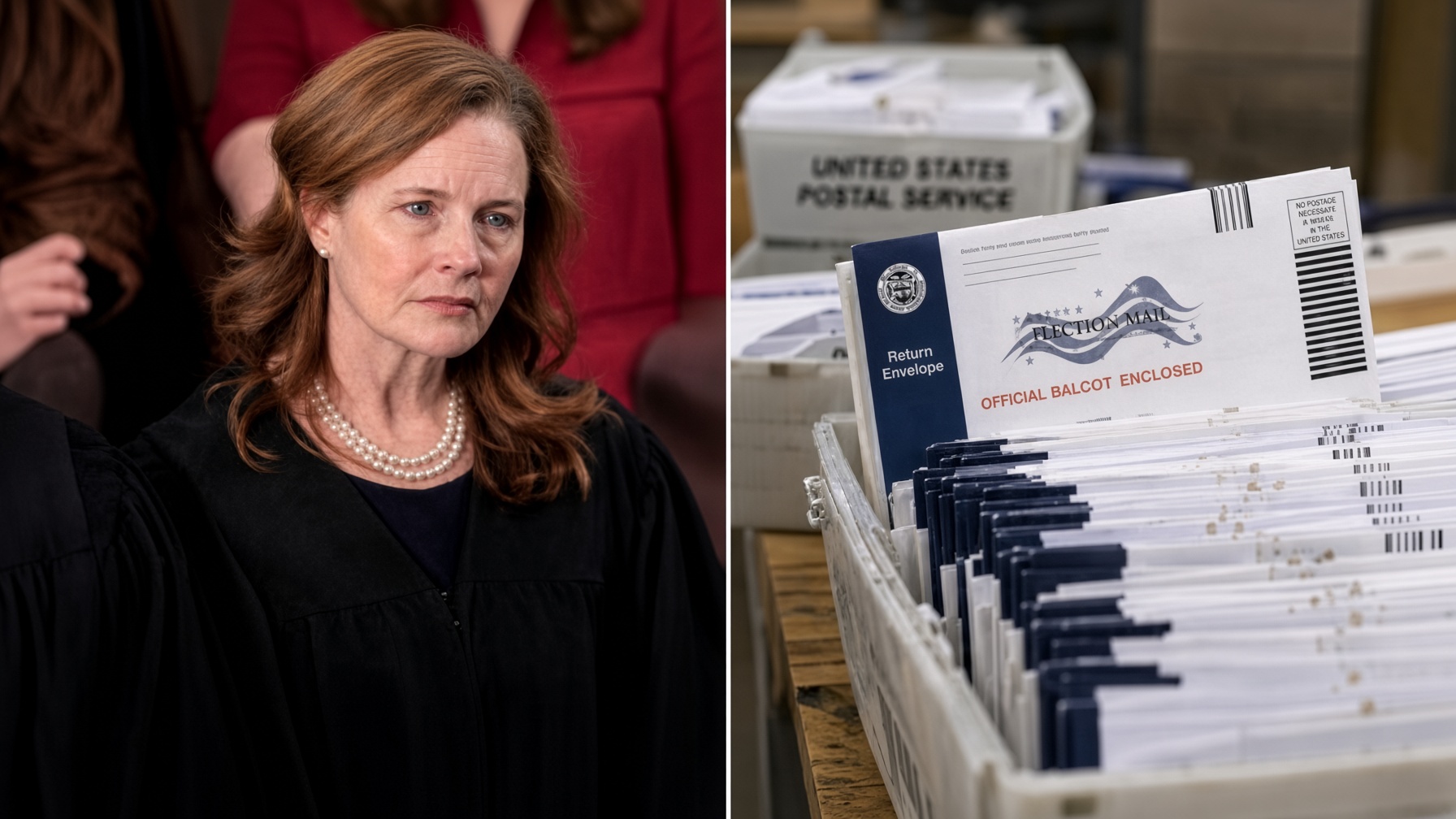
WASHINGTON — The Trump administration asked the Supreme Court on Thursday to immediately reinstate a contentious federal rule that would dramatically overhaul how the U.S. Postal Service handles mail-in ballots, setting off a high-stakes constitutional showdown less than two months before the November midterm elections.
The emergency petition seeks to lift a lower-court injunction blocking a finalized Postal Service regulation that requires states to submit centralized registries of approved mail-ballot recipients and mandate specialized, unique barcodes on all outgoing and return ballot envelopes. Under the agency’s framework, postal workers would be barred from delivering absentee ballots to any prospective voter whose name does not appear on an authenticated, state-certified eligibility roster.
The Justice Department’s direct appeal to the high court marks the latest escalation in a bitter, multi-front legal fight over an executive order issued by President Donald Trump in March, which sought to establish uniform national security baselines for mail-in voting. The clash has thrust the federal judiciary into the heart of election administration at the exact moment state election directors begin dispersing millions of ballots to registered voters.
A Rapidly Escalating Judicial Tug-of-War
The emergency application lands at the Supreme Court following a whiplash sequence of judicial rulings across the federal court system throughout late summer:
August Procedural Vacatur: The Supreme Court previously lifted an earlier nationwide injunction against the policy, holding on narrow procedural grounds that challenges brought by a coalition of Democratic-led states and civil rights organizations were premature because the Postal Service had not yet published its formal administrative rule. That order explicitly avoided ruling on whether the president possesses constitutional authority to mandate such requirements.
The District Injunction Lifted: In compliance with the high court’s directive, U.S. District Judge Indira Talwani dissolved her original preliminary injunction.
Renewed August Injunction: After the Postal Service promulgated its finalized regulations, plaintiffs immediately filed an amended complaint. On August 27, Judge Talwani issued a fresh preliminary injunction blocking key enforcement provisions of the finalized rule while the underlying constitutional litigation proceeds.
Bypassing the Circuit Bench: Facing imminent statutory deadlines, the Department of Justice filed an appeal with the 1st U.S. Circuit Court of Appeals while simultaneously lodging an emergency petition directly with the Supreme Court, urging the justices to intervene on the administrative shadow docket before the appellate court completes its review.
In emergency filings submitted to Chief Justice John Roberts, Solicitor General attorneys argued that the Postal Service holds broad statutory latitude to manage the security and integrity of mail processing. Administration lawyers maintained that the regulation does not usurp state sovereignty because individual states retain sole authority to determine voter qualifications and compile their respective eligibility lists.
Federal lawyers also dismissed claims that implementing the rule during active balloting would disenfranchise voters or create widespread chaos, arguing that the agency possesses adequate logistics to coordinate with local clerks and verify databases on a rolling basis.
The Federalism Divide and Voting Rights Concerns
Attorneys general from sixteen states and a coalition of voting-rights advocacy groups have mounted a fierce defense of the injunction, contending that the executive branch is attempting an unconstitutional federal takeover of an election infrastructure that the U.S. Constitution expressly delegates to the states.
The central thrust of the challengers’ lawsuits asserts that the executive order and resulting USPS mandates violate the Elections Clause of Article I, Section 4. Opponents argue that Congress has never authorized the Postal Service to withhold, delay, or condition the delivery of legally recognized state election materials based on executive mandates not grounded in federal statute.
Judge Talwani echoed those structural concerns in her rulings, noting that the plaintiffs are highly likely to prevail on the merits of their claims that executive agencies exceeded their congressionally defined administrative reach.
Opponents also warn that bureaucratic or technical errors in transmitting databases between county election offices and the federal portal could disenfranchise thousands of lawful voters. Under the policy, any clerical omission, spelling discrepancy, or data latency between state registries and the postal clearinghouse could cause carrier facilities to flag ballots as undeliverable, stripping voters of their ability to cast a timely vote.
Operational Clock Running Out as Balloting Begins
The battle over the rule has arrived at an acute operational bottleneck. North Carolina initiated outgoing absentee ballot distributions on Friday, becoming the first state to launch general election voting, with dozens of other states scheduled to follow suit throughout September and October.
State and county election directors have submitted detailed sworn declarations across federal dockets warning that the administration’s timeline is structurally untenable:
Procurement and Printing Lock-In: Millions of specialized security envelopes, return sleeves, and voter instruction packets were finalized and printed months ago under existing state procurement contracts. Scrapping existing stocks to integrate new federal barcodes would cost millions of dollars and cause weeks of delay.
Automated Processing Infrastructure: High-speed sorting optical scanners and county counting machinery have already undergone statutory logic and accuracy testing calibrated to existing state barcodes, leaving local election departments without sufficient lead time to re-engineer their technical pipelines.
Technical Portal Deficiencies: A central digital portal constructed by USPS to ingest massive voter registries from fifty states was not fully operational this week, leaving local administrators unable to test data-integration pipelines.
The administrative turbulence intensified after an internal Postal Service whistleblower alleged that agency executives had rushed the development of the database infrastructure, raising alarms that untested software could corrupt file transfers and delay ballot processing. The agency confirmed it is reviewing the internal claims while continuing to patch and test the software.
The High Court’s Pivotal Dilemma
The dispute places the Supreme Court in a delicate institutional posture under the Purcell principle, a judicial doctrine derived from the high court’s 2006 precedent that cautions federal judges against altering election rules on the eve of an election to prevent public confusion. While the administration contends that the district court violated Purcell by intervening, challengers counter that it is the federal government’s abrupt regulatory intervention that threatens to upend established state election operations.
As the justices review the emergency pleadings, states, local election administrators, and millions of prospective voters remain caught in an unresolved legal twilight, awaiting a definitive order that will determine how their ballots are handled when delivered to the mail stream.