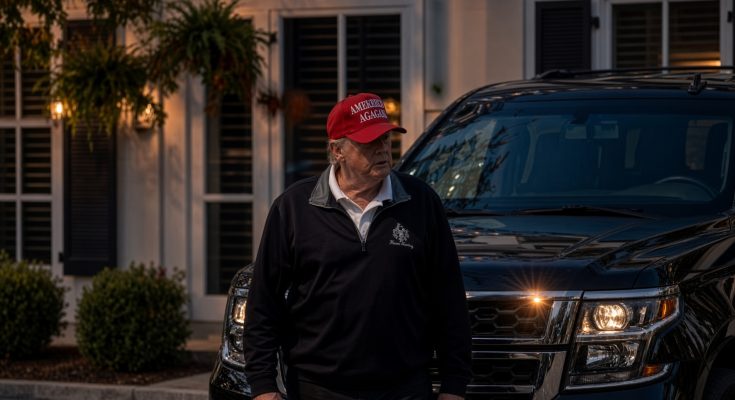
PALM BEACH, Fla. — An unverified late-night sighting purporting to show President Donald Trump walking through a Palm Beach perimeter in the early morning hours has triggered a wave of digital speculation, fueled by ambiguous visual snippets and uncorroborated social media claims.
According to posts circulating widely across multiple platforms, the president was allegedly observed shortly after midnight wearing casual attire and a baseball cap, moving without the overt logistical footprint that normally characterizes executive travel. The primary focus of public attention, however, centered on a small, indistinct object seen in his hand, which reportedly caught the reflection of overhead streetlamps as the figure moved beneath them.
Yet behind the viral traction lies a notable absence of factual corroboration: neither federal law enforcement, the White House press office, nor accredited pool reporters have verified the authenticity of the imagery, the precise date and time of the recording, or the identity of the person depicted.
The Mechanics of an Unverified Sighting
The episode highlights how quickly low-resolution imagery involving high-profile political figures can bypass standard verification channels and dominate social feeds.
Within hours of the initial posts, competing narratives emerged online. Some commentators magnified the sighting into a moment of clandestine intrigue, speculating without foundation on the nature of the handheld item—theorizing everything from specialized communications gear to personal security apparatus. Conversely, skeptical observers argued the footage showed nothing more remarkable than an individual carrying a smartphone, a key fob, or a personal accessory.
A third camp questioned the primary source material altogether, noting that grainy, compressed video files shared without metadata cannot reliably confirm identity, location, or timeframe. In an era saturated with sophisticated video manipulation tools and high-volume engagement farming, visual ambiguity frequently serves as an accelerant for partisan projection.
Presidential Logistics and Information Gaps
The sudden circulation of the claim underscores the operational contrast between public presidential movements and private routines.
Under standard operating procedures, any movement by a sitting president beyond a secure perimeter is heavily coordinated and documented by a dedicated press pool, uniform protective units, and tactical response teams. While routine public appearances are cataloged on daily guidance releases, an administration’s private estate logistics are governed by discretion.
When a commander-in-chief resides at a private property such as Mar-a-Lago, the inner perimeter is heavily guarded by the U.S. Secret Service, and internal foot travel within the secured boundary does not typically generate pool dispatches or public records. The absence of a formal event on a public schedule does not inherently signify secrecy; it merely reflects the demarcation between official public business and private residence routines.
Without official confirmation that the individual was outside a designated protective zone, the claim of an unusual, unescorted late-night walk remains an ungrounded inference rather than a confirmed logistical breach.
Context Versus Confusion: The January Security Sweep
The viral chatter has also caused confusion among casual observers by blurring the unverified rumor with a separate, fully documented security incident that occurred in Palm Beach earlier in the year.
In January 2026, the U.S. Secret Service executed an emergency detour of the presidential motorcade after advance security teams detected a “suspicious object” along a transit corridor near Palm Beach International Airport as the motorcade departed Mar-a-Lago. That incident was immediately confirmed on the record by the White House, the Secret Service, and regional law enforcement agencies, who explained that standard security protocols dictated an immediate route diversion while hazardous-device technicians inspected and cleared the area.
Unlike that established event, which generated an official paper trail, on-the-record briefings, and documented tactical adjustments, the current late-night walking narrative lacks any comparable institutional footprint. Conflating the two distinct narratives illustrates how verified historical occurrences are often co-opted to lend artificial legitimacy to subsequent unverified claims.
The Challenge of Algorithmic Amplification
For journalists and national security analysts, the rapid circulation of the Palm Beach imagery illustrates the ongoing challenge of separating fact from viral distortion in real time.
Digital platforms are optimized to amplify material that provokes curiosity, suspense, or emotional reactivity. When visual context is lacking and official clarity is withheld, digital spaces rapidly fill the void with speculation. In this instance, an unresolved visual fragment was transformed within hours into a trending narrative, despite the total absence of foundational details such as chain of custody, original source attribution, or corroborating physical evidence.
As it stands, the central questions regarding the purported midnight walk remain unresolved. No credible authority has confirmed where the recording originated, whether the footage depicts a recent encounter, or what item was carried. Until on-the-record documentation or forensic analysis provides tangible clarity, the episode serves not as evidence of a significant presidential event, but as a case study in how unverified imagery can capture public attention in an attention-driven digital landscape.