
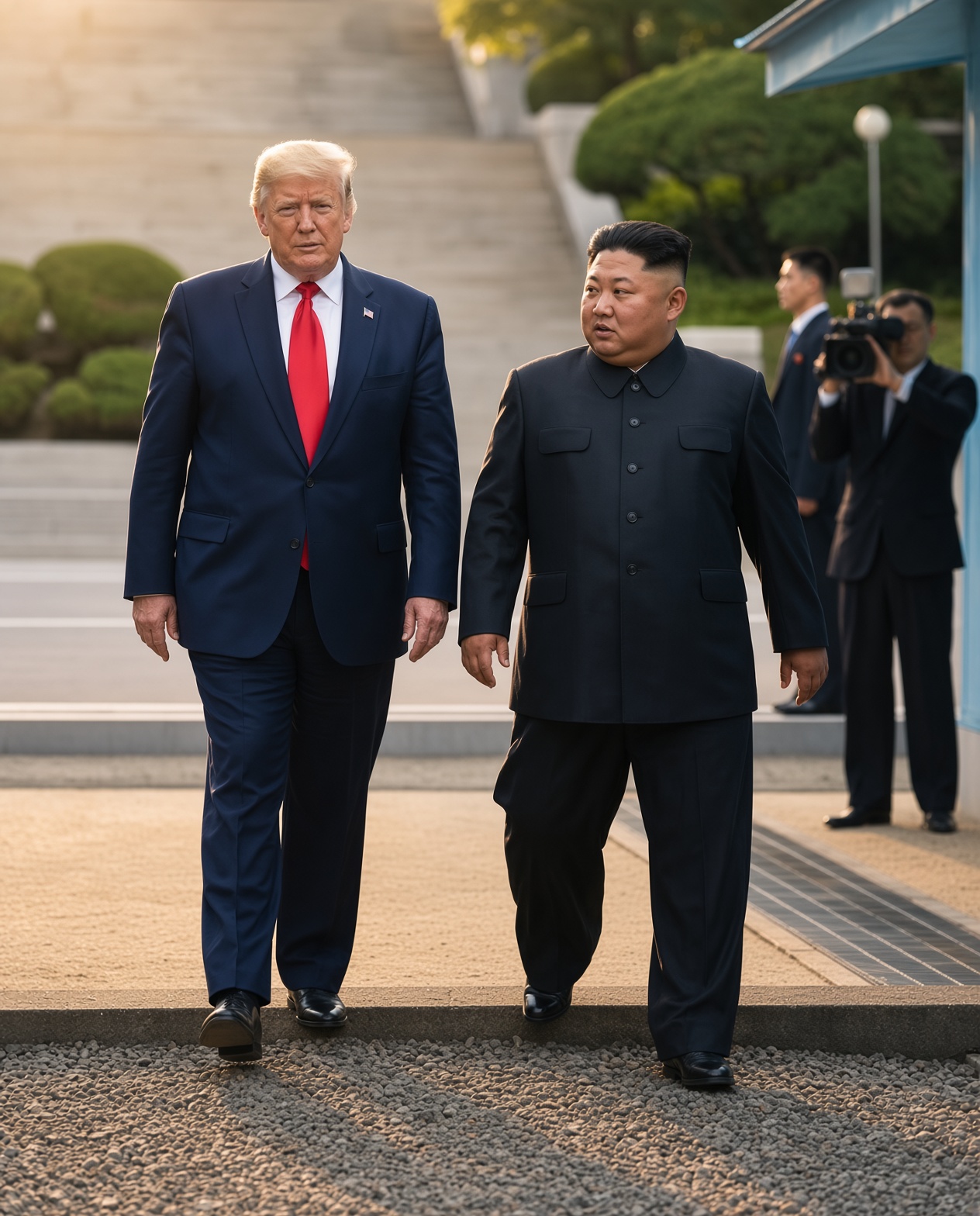
President Donald Trump directed the Pentagon on Sunday to reduce the annual joint military drills with South Korea, citing the ally’s refusal to assist with the conflict against Iran and referencing his “very good relationshiop” with North Korean dictator Kim Jong Un.
In a social media statement, Trump claimed that the exercises are not only expensive but “send a signal that is totally inappropriate and hostile” to North Korea, which he described as having been “has been unthreatening and respectful” throughout his presidency.
“Based on my very good relationship with Kim Jong Un, of North Korea, I am not happy with the fact that the United States has, long ago, agreed to participate in Joint Military Exercises with South Korea,” Trump wrote on Truth Social on Sunday.
Panic as North Korea launches enormous missile as fears of all-out war explode “Therefore, and based on the fact that it is too late to cancel, I have instructed Secretary of War, Pete Hegseth, to substantially reduce the Joint Military Exercises!” he continued.
Administration Criticism of Allies
The president went on to complain that he had recently approached South Korea’s president about joining the U.S. in the “denuclearization” of Iran, “and they said, ‘No thanks!'”
This decision represents another instance of the president seemingly distancing himself from an ally while favoring a leader whom prior administrations have regarded as an adversary. Trump and members of his administration have also criticized NATO allies over what they perceive as insufficient backing for his Iran campaign, even as these nations work to address an increasingly assertive Russia in the Baltic area.

This marks a significant shift from how his administration has characterized South Korea in recent months. Back in May, Hegseth commended the longtime ally for its “commitment to increase defense spending” and its “leadership in assuming primary responsibility for the security of the Korean Peninsula” during a Pentagon meeting.
“It demonstrates alliance burden-sharing that all of America’s partners would do well to follow,” the defense secretary stated.
Military Exercises and North Korean Threats
The 11-day exercises involving 18,000 South Korean troops were intended to strengthen preparedness against North Korean threats. The U.S. military has indicated that the summertime Ulchi Freedom Shield exercises bolster “the role of the alliance as the linchpin for regional peace and security” and reaffirm “the ironclad commitment between the United States and the Republic of Korea to defend their homelands.”
The exercises represent one of two primary combined drills conducted annually by South Korean and U.S. militaries, alongside their springtime training. U.S. and South Korean forces were set to conduct joint operations in challenging scenarios, including a live-fire exercise to evaluate joint precision targeting and maneuver, a wet gap crossing, and distribution of prepositioned military equipment, according to the U.S. military.
South Korea’s Defense Ministry verified that the exercises commenced on Monday as scheduled. The joint training kicked off days after North Korea resumed ballistic missile testing activities in violation of U.N. bans.

Democratic Sen. Mark Kelly, a former Navy pilot, strongly condemned Trump’s decision, stating in a social media post just hours after the president’s announcement that “hollowing out these joint exercises is shortsighted and a mistake” Earlier this month, intelligence from South Korea, the U.S., and Japan confirmed North Korea had launched two ballistic missiles-the regime’s first such weapons tests since late June.
North Korea’s Weapons Development
The projectiles came down in waters along North Korea’s eastern coastline. Since the breakdown of Kim’s ambitious diplomatic efforts with Trump in 2019, North Korea has aggressively expanded its nuclear and missile capabilities.
Analysts suggest Kim calculates that a more substantial weapons stockpile would strengthen his negotiating position and enable him to extract greater concessions from the U.S. in any future talks. On Friday, North Korea issued vague but stern warnings directed at the U.S. and South Korea, characterizing their joint military exercises as “a rehearsal for an aggressive war” that heightens regional tensions.
Such inflammatory language is characteristic of North Korea’s typical response ahead of significant U.S.-South Korean military drills. Analysts note that North Korea frequently leverages its adversaries’ training exercises as justification to accelerate weapons testing programs aimed at modernizing its arsenal and bolstering domestic support for the isolated North Korean leader.
During his first term, Trump held three meetings with North Korean leader Kim Jong Un to address the country’s nuclear ambitions, with the most recent encounter taking place in 2019. Since reclaiming the presidency, Trump has signaled his desire to resume those diplomatic discussions.
Trump’s History with North Korea
In September 2025, Kim acknowledged having “good personal memories” of Trump, hinting at a possible return to negotiations should the U.S. abandon “its delusional obsession with denuclearization” of North Korea. Trump’s latest announcement came a day after he posted a photo alongside Kim on social media, noting that the two leaders share a strong rapport “despite the unfriendly look on this particular picture.”
This marks yet another instance of Trump seeking to halt joint military exercises, having previously made a surprise declaration during his first term that labeled the war games “provocative. “We will be stopping the war games, which will save us a tremendous amount of money, unless and until we see the future negotiation is not going along like it should,” Trump told reporters following his landmark 2018 summit with Kim in Singapore.