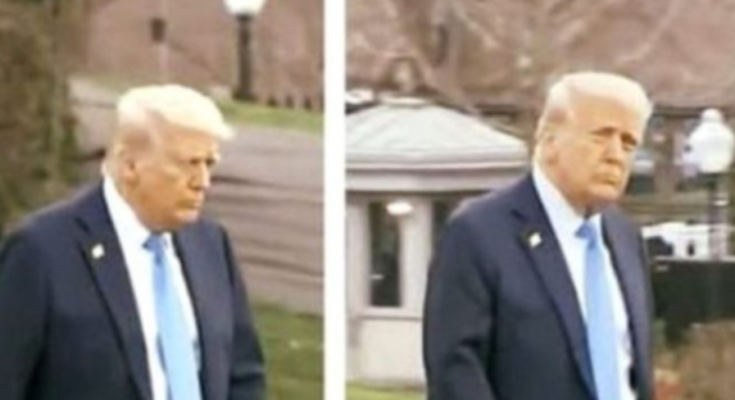
WASHINGTON — Resurfaced photographs showing Donald Trump boarding Marine One across the White House South Lawn have ignited fresh debate across social media platforms, highlighting how routine political imagery can be detached from its original context and transformed into a vector for online speculation.
The images, which originally circulated in 2025 before gaining renewed traction, capture Trump walking toward the presidential helicopter used for executive transport. Rather than focusing on the official itineraries or state business documented during those movements, online commentators quickly zeroed in on visual details—scrutinizing Trump’s gait, posture, wardrobe fit, and physical silhouette.
The episode underscores a recurring dynamic in the modern media landscape: the rapid convergence of visual micro-analysis, partisan reaction, and unverified health claims in digital spaces.
Online Scrutiny and Speculative Narratives
As the pictures recirculated, social media users offered competing interpretations of Trump’s appearance, with some drawing comparisons to earlier public engagements and suggesting shifts in his physical stamina. The discussions swiftly merged into broader, recurring internet chatter concerning the health and lifestyle of prominent political figures.
Fact-checkers and media analysts regularly caution that still photographs and short clips taken during brief, controlled public movements provide an unreliable foundation for evaluating medical fitness. Past visual controversies involving public figures have often relied on edited angles, freeze-frames, or digitally altered files. A widely shared 2017 photograph of Trump boarding Marine One, for instance, was famously altered by online users to exaggerate his physical dimensions, as documented by fact-checking outlet Snopes.
Even with unaltered archival images, lighting conditions, tailoring choices, and brief physical adjustments can create visual impressions that bear little connection to clinical reality. Despite widespread armchair diagnoses across message boards, no verified medical disclosures or credible clinical findings have substantiated the latest waves of viral commentary.
Medical Record and Public Statements
For his part, Trump has consistently maintained in interviews and public addresses that he remains in robust health and capable of executing an intensive travel and speaking schedule. Throughout his political career, his age and lifestyle—frequently characterized by high-profile rallies, irregular sleep schedules, and well-publicized preferences for fast-food staples—have attracted consistent public and media scrutiny.
Official White House medical summaries released in recent years have sought to counter periodic rumors. Disclosures compiled by White House medical staff, including reports detailed by the Associated Press, have affirmed that Trump remains fit to perform executive duties, documenting evaluations across cardiovascular, pulmonary, and neurological performance while noting routine lifestyle recommendations such as regular exercise and weight management.
While age and fitness remain standard topics of public interest among world leaders, medical experts emphasize that chronological age alone cannot predict an individual’s health status without thorough diagnostic testing and professional clinical assessments.
Visual Velocity in Digital Journalism
The renewed focus on the Marine One imagery highlights the vulnerability of political reporting and public perception to algorithmic amplification. In contemporary digital environments, visual content often circulates within engagement-driven feedback loops that reward emotional, dramatic, or speculative reactions over measured context.
The same photograph can easily be repurposed across varying news cycles, stripped of dates and official press pool captions to fit shifting political narratives. A routine departure from the South Lawn, initially recorded by photojournalists as part of the visual archive of government operations, becomes repurposed months later as a political litmus test.
Communication researchers point out that public figures exist under a form of perpetual observation where minor mannerisms, a missed step, or a momentary expression can generate speculative reporting across international outlets.
The resurgence of the Marine One photographs illustrates how modern political archives are continuously recycled by digital audiences. Because social media algorithms often operate without chronological guardrails, media analysts stress that establishing verified timelines, consulting primary reporting, and relying on corroborated medical records remain essential safeguards against visual misinformation.